Friday, 1 October 2010

Analysis of Memento

"Memento" is a 2000 American psychological thriller film which portrays two separate stories of Leonard, an ex-insurance investigator who has anterograde amnesia so can no longer build new memories, as he attempts to find the murderer of his wife which is the last thing he remembers. The events of the film unfold in two separate alternating narratives, one in black and white which moves forward chronologically in time, whilst the other in colour tells the story in reverse order, revealing more each time. As each sequence begins, the audience is unaware of the preceding events, just like Leonard, thereby giving the viewer a sense of his confusion and being able to relate to him. The film starts with Leonard killing Teddy for the rape and murder of his wife, then as the film ends when the two narratives converge, we understand the events that lead up to Leonard killing Teddy.


“Memento”, is one of those films whereby the ending is shown at the beginning, so in the opening clip of the film we can Leonard shooting Teddy, which is shown in colour as it is the end of the film and going in reverse chronological order. The clip moves backwards as we see the image on the Polaroid photo vanish, it’s then put back into the camera and the bullet is reloaded into the gun before Leonard pulls the trigger. At 1:44 the edit cuts to black and white to show Leonard in a hotel room, to represent the forward chronological order of the story. The use of the non-diegetic music helps to create apprehension and suspense, hence engaging the audience and at 1:42 the music builds to a climax and increases in volume as Leonard is waiting to pull the trigger of the gun. We have discussed when we come to edit our film, we may decide to use different lighting to portray the two different lives that our main character could lead, hence making it more obvious and less confusing for our demograph.

"Memento” also includes a voiceover in some parts, which is something we are looking into when we create our short film. This is because, as it revolves around one character there is no need for dialogue, so we thought that a voiceover may be needed to assist the audience. However, we also think that just the footage and a suitable piece of non-diegetic music may be more effective.                                                                                                         
Although our film is of a different genre, “Memento” can be classed similar to our short film, as they both have two alternative narratives, however in “Memento” they are going in opposite orders but telling the same story, whereas in our film, they are running parallel, yet portraying two different lives.

If we look at the poster for “Memento”, it has been cleverly constructed to portray Polaroid photos within other Polaroid photos, relating to a memory inside a memory. The Polaroid photos are one of the key features of the film, as Leonard has short term memory loss, so has to take pictures of everything to help him in his investigation to find out who killed his wife. Moreover, the use of font at the bottom of the Polaroid picture, stating the title of the film has been written in quite a handwriting style font, thus relating to the film, in which once he takes pictures he writes a description, which he normally has tattooed to himself so he doesn’t forget. Therefore, this poster reflects the film vastly and includes the tagline “Some memories are best forgotten”, which is ironic to the film, as the last memory he can remember is of his wife being killed, yet he forgets everything else.

Anaylsis of The Family Man

The Family Man is a 2000 comedy-drama film which centers on a single wealthy man, living in his penthouse in New York City. However all that changes when he wakes up one morning in New Jersey with a wife and two kids he never had. He discovers that he is living in an alternative universe, where not even his closest friends recognize him and he is being shown what his life could have been like, had he made a different decision thirteen years ago.

This film could be compared similarly to ours, as they are both about making life changing decisions and they both contrast family life with achieving success and wealth at work.

Analysis of Sliding Doors


Sliding doors is a 1998 film of a drama and romantic comedy genre. The film revolves around the main character Helen, played by Gwyneth Paltrow and the plot splits into two parallel universes, based on the two paths Helen’s life could take depending on whether she catches a London Underground train or not.

Although the storyline of Sliding Doors does sound very similar to our plot line for our short film, they both include a train and two different lives that our main character could live. However, none of the members of our group have actually seen the film sliding doors, so this is something we are looking into for inspiration on how to make our short film a success.


In the above clip, we see the main character Helen, dashing to catch her train on time, where two possible outcomes are portrayed – the first where she misses the train, and the second where she catches it. These storylines are both running parallel at the same time as we see the train leaving with her in it, connoting how she caught the train; however we also see her standing on the platform, implying how she missed the train. So now she goes on to live two separate lives following the events which occurred at the train station with her missing and catching the train.

At 0:50 we see time rewind as she is seen walking backwards away from the train and back up the stairs and the other people on the platform are also seen going back in time. Then at 0:57, time restarts again correctly and she is seen making her way down the stairs towards the train. Near the end of our short film, we want to include something similar to this whereby, everything that our main character has experienced during his flash forwards of the two lives he could lead, rewind back quickly to present day to show him stood on the train platform, conveying how it has just all rushed through his head.

The non-diegetic music during this scene helps to convey mystery and fantasy, especially when time is rewinding, as obviously this is something which cannot be done. At the start of the time rewinding, a chime sound can be heard which is then repeated again when the time restarts correctly, thus signifying how time change has happened and how a different outcome will now arise, so help keeps the audience interested and aware of what is happening. At the beginning of this clip, the non-diegetic music accompanying the video footage is quite peaceful, however at 0:18, as we see the train approaching and it cuts back to show Helen moving through people on the escalator in quite a rush, the tone of the music changes to replicate quickness and a sense of mystery, keeping the audience engaged to see what will occur. The sound of the chime is also used at 0:38 and a 1:08 when the little girl is playing with her doll as she walks up the stairs. In my opinion, the use of the same particular sound in both accounts reflects how the action occurring on screen at that time is very important. This is because, it is the actions of the little girl which makes Helen miss her train, as the first time the little girl delays her by being in the way, yet the second time her dad moves her out of the way and Helen is able to catch her train.

The non-diegetic music also has a momentum to it, which links in with her being in a rush to catch the train on time. In our film, we are planning to not include dialogue, as we think it will not be relevant and will be more appealing for our demograph if we just have our footage with appropriate non-diegetic music. Therefore, the type of music we choose needs to be important, as in this clip from Sliding Doors the non-diegetic music conveys fantasy, so reflects the genre of this film. It also creates suspense, hence keeping the audience interested and can reflect the mood of the characters due to the actions which are happening on screen. Diegetic music is also incorporated, for example the sound of the train and footsteps, all helping to create verisimilitude.

At 1:12 the pace of the edit changes into slow motion, as she just manages to stop the train doors from closing whilst she gets on the train, before returning to normal pace again at 1:17. During the slow motion the non-diegetic music decreases in volume and when it returns to normal pace it has a slightly happier feel to it, connoting how she caught the train on time and is pleased about that. Then, when the camera pans to show her outside the train, the music changes to imply a sadder tone, reflecting how she missed the train. In our film, when our main character sees a women fall over on the train platform, we would like to have that shown in slow motion, as we feel it is a very significant part of the film, as it portrays how he has a decision to make regarding the women; whether he helps her or ignores her to catch his train, determines the life which he will lead. Additionally, we shall have to choose a very distinctive sound when she falls over, also connoting how this is an important part to our film. Therefore, the use of slow motion and the non-diegetic music helps to convey important aspects of the film to the audience.

Also, I think the shot at 0:22 is an interesting shot and different from the others of Helen being in a rush. The footage has been edited to switch between the train approaching and Helen in a rush to catch her train on time. At 0:28 the pace of the editing speeds up, as it switches much quickly between the train and Helen, indicating how something is going to happen soon and that the train and Helen will finally meet.

Regarding mise-en-scene, this is accurate as the setting creates verisimilitude and the use of extras at the train station and those departing the train also help to make things believable for the audience.

Therefore, there are many features that are employed within this short clip from Sliding Doors which we are hoping to include in our short film, for example: slow motion and time rewinding.


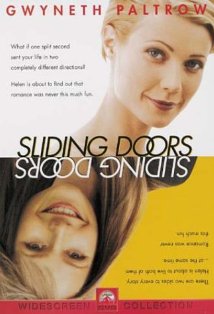
Another feature we must consider is the poster of “Sliding doors”, as creating a poster is one of our ancillary tasks. The poster of “Sliding doors” is quite effective, as it shows the 2 different paths of life that the main character “Helen” could lead, one at the top of the poster, and the other upside down at the bottom of the poster, like a mirror image reflecting how in the film the two lives are running simultaneously, yet involve leading her in completely different directions within life. Therefore, this is something that we can use as inspiration when we come to construct our poster, as our short film comprises of two different lives also.

Friday, 24 September 2010

Our Ancillary Tasks

We have decided that our ancillary tasks will be the poster and the film magazine review. We did not want to create a radio trailer as we felt they are quite uncommon.

Wednesday, 22 September 2010

Short Film Concept

After lots of careful consideration and discussions, we finally came up with a concept for our short film. It is of a drama genre. The main concept of it is: A gentleman called Lucas is at a train station on the way to a job interview. Whilst waiting for a train, he sees a woman called Grace falls over and drops her papers in front of him. He then begins two flash forwards. One where he leaves the woman and walks directly past her to get on his train, gets to the job interview on time, and successfully acquires the job. However, even though he has a luxurious life, lives in a posh mansion, and drives a fast car, it doesn’t mean that he is living a happy life. The second flash forward shows what would happen to him if he helped Grace after her fall. Although he misses the job interview, Grace turns out to be his wife; they get married, buy a house and live a happily together. At the end of both flash forwards he receives a letter. In the first flash forward it states that he has received a promotion at work, and in the second flash forward, it is confirmed that his wife is pregnant. He then comes back to reality and has to make the decision of which life he intends to lead.

So, this is the concept for our film and although it is of a drama based genre, it does have elements of fantasy and mystery to it. This is because Lucas is having these flash forwards, and the fact that it will be left to the audience to decide upon which path of life he will choose.

As we have our concept, we now need to develop our research further. We are going to analyse films of the similar genre to ours, to make sure we include similar conventions in ours. Furthermore, even though we have never seen the film “Sliding Doors”, we were told that our concept was very similar to that film, which is something we shall look in to. We will then need to find our actors, locations and create our storyboard, entailing the specific shots we are going to include, and must keep in mind: lighting, sound, mise-en-scene and continuity, so verisimilitude is obtained at all times.

We think it will be a bit challenging to produce this film, especially as we are filming at a train station, and we will need older actors. However, we believe that it has a good concept, which will hopefully interest the audience and keep them engaged throughout the film.

Analysis of Short Film – Telling Mark

BBC Short Film - Telling Mark - http://www.bbc.co.uk/filmnetwork/films/p004ph4q


As we have decided that we are going to create a short film for our A2 coursework, I have analysed the short film: “Telling Mark”. This film is of a drama genre, which is the same genre as the film we are going to create.

In this film, Mark and Carlotta have some news to tell Mark’s workmates, which is that they are having a baby, yet they also have some news to tell Mark, which is that Carlotta is dead and Mark doesn’t realise it. I think the storyline is very effective, and although is not of a detective genre, it includes enigmas as it is not until the end of the film that we realise that Carlotta is actually dead. Therefore, no dialogue is exchanged between Carlotta and Mark’s workmates, and there is no acknowledgement from them that she is there, yet it is not obvious that they are ignoring her either. Therefore, this makes sense at the end, and is a surprise to the audience that she is dead, and Mark is the only one who believes she exists and can see her.

Regarding camera shots, this film includes the usual shot reverse shots, over the shoulder shots, and close ups. The use of high angle and low angles shots are also incorporated within this short film, to connote who the dominant characters are, and those who are not so powerful. The use of zooming in to closer shots also indicates how the storyline is getting more intense, with the fact that secrets/news is being revealed. Towards the end of the film, when Mark and Christina are discussing the events of the car accident, high angle and low angle shots are used, connoting who has the most power, yet when Christina stands up, this reflects how the proxemics between them have changed, as he realises that she is correct with what she has been saying. The use of focus is also employed to emphasise certain characters in particular, reinforcing their importance within the film.

Regarding diegetic sound, it was interesting how no dialogue was exchanged until 1 minute into this short film, so we are making our impressions on these characters by the use of shots and the actions they are carrying out on screen. For example, in the beginning, we see shots of Mark and his wife together in the kitchen, and then a shot of Mark in the living room, hence making us aware of where the action is going to be taking place in this film, and that Mark is the main character. We can tell that Mark and Carlotta have a good relationship from their proxemics. Other diegetic sounds are also included to create verisimilitude, for example the telephone ringing, the mobile phone ringing, the knock at the door and the sound of him being sick.

The use of the non-diegetic music helps to convey a sense of mystery about the film, with the fact that news is about to be revealed, which will be a surprise and a shock for the characters in the film, and also for the audience. Therefore, the use of the non-diegetic music at certain points in this short film, helps to create suspense and tension, thus definitely ensuring that the audience is interested and continues watching to see the outcome. For example, I really liked how the non-diegetic music was used effectively when Mark’s guests were gathered outside the front door, as at that point the non-diegetic music volume increases, connoting how something is going to happen, and creates apprehension, thus making us more aware of what’s happening on screen, and then when Mark opens the door, the non-diegetic music stops abruptly. This same effect is used later on, when Mark is talking about the car accident, and when he stands up and shouts “no”, the non-diegetic music stops, conveying how he did not like what he was hearing.

The lighting changes when Christina sits down in the chair that Carlotta was supposed to be sat in, and this is when Mark realises that Carlotta died in the car accident, as he can hear the voices in his head of what happened on the night of the fatal car accident. The use of the change in lighting is very effective as it conveys that what he is re-living in his head has happened in the past, yet now he has finally realised the truth. Regarding mise-en-scene, the apartment is fully furnished and equipped with what you would expect, thus creating verisimilitude.

The use of parallel action is also integrated within this short film. For example, Mark and his wife are talking about the guests’ arriving, which then cuts to a shot to show his three guests talking.

As it is a short film, we do not have time to get to know the characters well, like we do in a standard length film. So the dialogue and props within the scenes have to give us as much information as possible about the characters. Therefore, the fact that Mark has a scar on his face, helps to make the audience more intrigued into how he got that.

In my opinion, Telling Mark is a poignant and complex storyline, yet is portrayed with simplicity, due to the fact there is not too much dialogue. Moreover, it has mysterious elements to it and the use of different lighting near the end both help to keep the audiences interested.


Ideas for A2

We have decided that for our A2 coursework, we are going to create a short film. As our 2 minute film opening last year was for a child genre, this year we have decided that we want to experiment with creating a film for a different genre, hence with the aim to reach a different intended audience.

At first we decided that we wanted to create a trailer, about a girl who goes missing, as we thought we could include many of the detective conventions within our trailer, for example: enigmas and retardations. However, we then realised that we are going to need to show many different scenes from within our film, which would mean a variety of different characters and settings, and we were worried that we would have difficulty finding suitable actors and locations, thus making our trailer turn out to be not as effective as we would hope. Therefore, we then decided that a short film would be much better, however we still have the dilemma of coming up with an idea that has a good storyline, yet is also appropriate for us to produce.